lguinee's blog
Social Justice Philanthropy: An Initial Framework for Positioning This Work
Submitted by lguinee on Mon, 05/10/2010 - 11:25A paper by Albert Ruesga and Deborah Puntenney discussing eight different (and overlapping) traditions of social justice on which philanthropic practitioners base their practice.
Values and Practices That Are Important for Good Social Justice Grantmaking
Submitted by lguinee on Mon, 05/10/2010 - 11:20In early 2010, the Working Group on Philanthropy for Social Justice and Peace took an unapologetically normative approach to the question, "What is good social justice philanthropy?" Here we Take a stab at describing the values and practices we believe are imperative for social justice grantmaking. Our aim was not to cut off debate but to encourage it, to create a space in which our differences can be aired and we can all find ways to improve our work. In retrospect, we will be developing a description both of the aspirational values and practices underpinning social justice philanthropy - and what we believe are the non-negotiables.
Take a look. What do you think?
Strategy Testing: An Innovative Approach to Monitoring Highly Flexible Aid Programs
Submitted by lguinee on Fri, 10/23/2015 - 08:57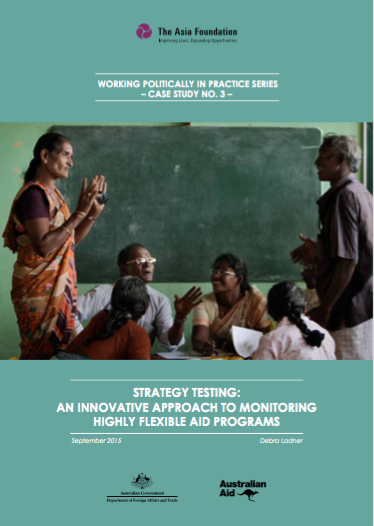 The attached new Asia Foundation paper describes an exciting new monitoring system developed by The Asia Foundation called Strategy Testing (ST). "ST was developed to track programs that are addressing complex development problems through a highly iterative, adaptive ‘searching’ approach. Traditional monitoring methods are designed to track progress in linear, largely pre-planned projects where the result and the path to achieving it are known from the outset. Such methods are poorly suited to contexts where specific results emerge over time in the course of implementation, and where there is a need to track shifts in program strategy and action. ST is designed to fill this gap. The paper provides a detailed description of the ST approach and the tools developed to facilitate the process.
Quiet Leadership: An Evening with Albert Ruesga
Submitted by lguinee on Thu, 02/05/2015 - 15:55
A blog post about an evening with Albert Ruesga by Patrice Relerford: "Quiet leaders are more inclined toward action than talking. These men and women also take the time to assess a situation and map out the best way to proceed. I’m sure the fact that Ruesga seems inclined to think before he speaks has served him well since he moved to Louisiana in 2009."
Find Ms. Relerford's full blog post here: http://blog.mcf.org/2015/02/05/quiet-leaders-and-philanthropy-a-good-fit/
Neighborhood Funders Group Launches FundersforJustice.org
Submitted by lguinee on Fri, 12/05/2014 - 20:25 Dear Friends,
We are grieved and outraged to see, in just a week’s time, two grand juries fail to indict police officers who killed unarmed black men: Michael Brown in Ferguson, MO, and Eric Garner in Staten Island, NY. In just the past few weeks alone, more black men and children have been killed or harmed by police. In response, hundreds of thousands of people in cities across the country, and across the world, are rising up, walking out, boycotting, dying in, and shutting down cities to say that Black lives matter.
Sri Lankan Rights Activist Sithie Tiruchelvam Passes Away
Submitted by lguinee on Mon, 03/24/2014 - 18:00We were very sad to learn that Sri Lankan rights activist, and noted member of the Foundations for Peace Network and the Philanthropy for Social Justice and Peace Network passed away. Learn more here.
Bringing Grantmaking In from the Cold
Submitted by lguinee on Tue, 03/04/2014 - 17:28Barry Knight and Jenny Hodgson have written an excellent framing article for the current issue of Alliance Magazine, describing the important role of grantmaking as a tool for social change. They open by saying, "Increasingly, the practice of grantmaking as a tool for bringing about social change has fallen out of favour, replaced by newer, snappier-sounding forms of philanthropy. In laying out their wares, venture philanthropy, strategic philanthropy, philanthrocapitalism and, most recently, ‘catalytic philanthropy’ have all made claims for greater effectiveness." The full text of the article is available on the Alliance Magazine website here.
Achieving Social Change - What Role for Grantmaking?
Submitted by lguinee on Mon, 01/06/2014 - 16:40Join Alliance Maagzine for a Webinar on January 14 from 10:30AM-12PM EST
Space is limited.
Reserve your Webinar seat now at:
https://www3.gotomeeting.com/register/656456326
Increasingly, grantmaking is being dismissed as a serious strategy for achieving social change, with the real business being done by venture philanthropy, strategic philanthropy, and most recently catalytic philanthropy. This webinar roundtable will bring together proponents/practitioners of different approaches to philanthropy to look at grantmaking as a strategy for achieving social change – not as the strategy, the truth, but as one of a number of approaches that funders can use.
Taking part will be:
• Matthew Bishop, co-author of Philanthrocapitalism
• Kathleen Cravero, Oak Foundation, Switzerland
• Stephen Heintz, Rockefeller Brothers Fund, US
• Avila Kilmurray, Community Foundation for Northern Ireland, UK
• Rana Kotan, Sabanci Foundation, Turkey
• Mark Kramer, FSG, US
• Bongi Mkhabela, Nelson Mandela Children’s Fund, South Africa
Have Foundations Become More Powerful?
Submitted by lguinee on Fri, 09/27/2013 - 12:00By the following members of the Working Group on Philanthropy for Social Justice and Peace: Ana Criquillion, Barry Knight, Atallah Kuttab, Halima Mahomed, Stephen Pittam, Chandrika Sahai and Suzanne Siskel.
Courtesy of www.alliancemagazine.org
On 8 July members of the Working Group on Social Justice and Peace held a webinar to talk about power and philanthropy. Something that isn’t much discussed, it seems. ‘The issue of power in philanthropy feels like the elephant in the room,’ said one participant. ‘How little we talk about power within philanthropy,’ said another. One particularly interesting issue that came up was the relationship between power and visibility: does greater visibility for foundations mean more power? Or does greater power come from a relative decline in the power of other institutions? What follows is not a fully-fledged article with a beginning,
a middle and an end but some extracts from a fascinating conversation among a group of people who know each other well and think about these issues a lot.
Click on the attachment to read the article.
What's Power Got to Do With It?
Submitted by lguinee on Fri, 09/13/2013 - 09:20By Linda Guinee and Barry Knight
Courtesy of www.alliancemagazine.org
The first question is: what is power? The simplest and one of the most effective formulations comes from feminist psychologist Jean Baker Miller, who defines power as ‘the capacity to produce a change’.
Probing deeper, however, reveals a complexity that is hard to fathom. There are many books and articles about what power is, where it comes from, and how it operates. According to earlier conceptions, power is the ability to force people to do something they wouldn’t have done otherwise. This is a ‘coercive’ definition of power that remains at the root of our common vernacular.
